A-Level Tutoring: How to Choose a Tutor Across Maths, Sciences and Essay Subjects
A-level is a different kind of course from GCSE, not just a harder version of it. Content goes deeper into fewer topics, most subjects are assessed on everything at once at the end of Year 13 rather than in modules along the way, and a much larger share of the learning happens outside timetabled lessons. Families who hire a tutor on the GCSE model, one session a week to plug gaps before an exam, often find that A-level tutoring needs a different shape, and that the shape is not the same in maths and the sciences as it is in history, English literature or psychology.
In short: A-level tutoring runs across two full academic years, Year 12 and Year 13, with results published in mid-August and university offers made and confirmed in grades through UCAS. In maths and the sciences, tutoring tends to focus on problem-solving fluency and building up the layered, synoptic content that earlier modules feed into. In essay subjects, it tends to focus on argument, evidence and exam technique under timed conditions, plus, in some subjects, supervision of coursework. In both cases the tutor's job is to support independent study, not to replace it.
How A-level differs from GCSE
Three changes matter most when thinking about tutoring.
Depth over breadth. A-level specifications cover fewer topics than GCSE but go far deeper into each one, and questions increasingly draw on more than one topic at once. Maths and science subjects call this synoptic assessment: a final-exam question can combine content taught in the first term of Year 12 with content taught in the last term of Year 13. Essay subjects show the same pattern differently, expecting a longer, more sustained argument drawn from several parts of the course rather than one topic.
More independent study. Schools generally expect several hours of private study for every hour of timetabled A-level teaching, covering wider reading, past papers and consolidation that GCSE lessons would have built in. This is the single biggest adjustment for pupils moving up from GCSE, and it is also where tutoring can help, or, used badly, get in the way.
Coursework and non-exam assessment (NEA). Some A-level subjects, including art, some sciences, and some English and humanities options, include coursework or an NEA component marked apart from the written exams and often weighted into the final grade. Where this applies, a tutor's role shifts for part of the year from exam preparation to supervising research, structure and referencing on a piece of extended, independently produced work.
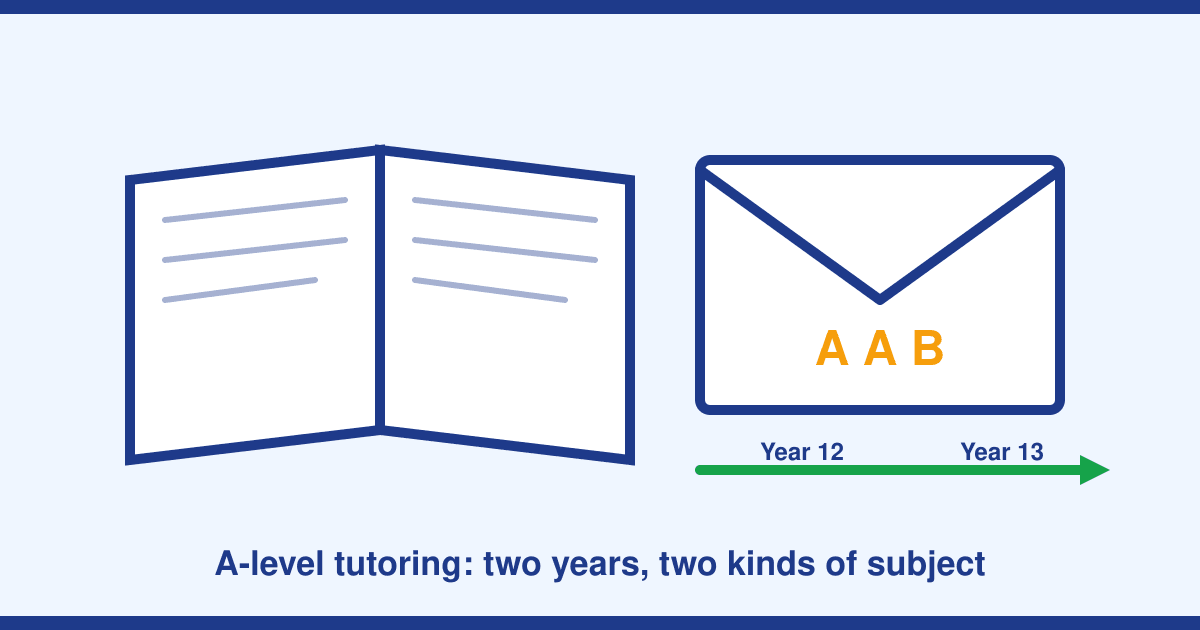
The two-year timeline: Year 12, Year 13, results day
A-levels are studied over two years in England, Wales and Northern Ireland, with almost all subjects examined in full at the end of Year 13 rather than through modules taken along the way.
- Year 12, autumn to summer. New subjects, often four narrowing to three, taught from the start at a pace and depth well beyond GCSE. Many schools set internal exams in the summer term that stand in for Year 11 mocks.
- Year 13, autumn. The rest of the content is taught, UCAS applications are submitted (an October deadline for medicine, dentistry, veterinary science and Oxford or Cambridge; a January deadline for most other courses, with the exact dates published by UCAS each cycle), and predicted grades go on the UCAS form.
- Year 13, January to Easter. Mock exams, often the most realistic indicator a family will see of where final grades might land, followed by a shift to revision and past papers.
- May to June. The written exam papers, spread across several weeks, alongside deadlines for any remaining coursework or NEA.
- Mid-August. Results are published, and for most applicants this is also when a conditional UCAS offer, made in specific grades such as A A B rather than as a place regardless of result, becomes unconditional or falls through.
The practical consequence for tutoring is that there is more runway than at GCSE, but also more ground to cover, since most marks in most subjects rest on the final exams rather than on earlier work.
What a tutor does differently in maths and science versus essay subjects
The day-to-day work of an A-level tutor looks quite different by subject group, even though the underlying evidence, drawn from the Education Endowment Foundation's Teaching and Learning Toolkit, applies across both: one-to-one tuition is associated with around five months of additional progress on average, and small-group tuition around four months, provided sessions are regular and closely linked to what the school is teaching.
| Subject group | What tutoring mainly targets | Typical session focus |
|---|---|---|
| Maths, further maths, physics, chemistry | Fluency in method and synoptic problem-solving | Worked problems, past-paper questions that combine topics, spotting which technique a question is asking for |
| Biology and other applied sciences | Application of knowledge to unfamiliar contexts, plus practical-skills questions | Data analysis, evaluating experimental method, linking recall to explanation |
| History, English literature, religious studies | Building and structuring an argument under time pressure | Essay planning, use of evidence and quotation, comparing interpretations, timed writing |
| Psychology, sociology, economics | Applying named studies, theories or models to new scenarios | Structured short-answer and extended-response practice, evaluation points |
| Subjects with coursework or NEA | Independent research and extended writing | Topic choice, structure, referencing, feedback on drafts rather than exam technique |
In maths and the sciences, a tutor is often working at a whiteboard, walking through method step by step and setting problems that force the pupil to choose the right technique rather than follow one already given. Progress is comparatively easy to see, because a method is either applied correctly or it is not.
In essay subjects, the tutor's role leans more towards questioning: pushing a pupil to justify a claim, weigh one piece of evidence against another, or explain why an examiner would reward one interpretation over another. Progress is judged against mark schemes and examiner reports, and improvement tends to be slower to show between sessions.
Subject specialists and exam-board familiarity
At A-level, subject specialism matters more than at GCSE, and general "all-round" tutoring becomes less useful. A tutor who studied the subject to degree level, and ideally has taught the current specification, will know which topics tend to be tested together and what an examiner wants in a top-band answer. Exam board also matters: AQA, Pearson Edexcel, OCR and WJEC Eduqas set different papers and question styles even for the same subject title, and past papers from the wrong board can waste revision time. Parents should ask the school which board is used and check the tutor is working from the matching specification and mark schemes.
Questions to ask, and keeping tutoring in its place
Before hiring an A-level tutor, it is worth asking:
- What is the tutor's own background in this specific subject, and have they taught this exam board's current specification?
- How will sessions adapt between Year 12, when content is still being taught, and Year 13, when revision and past papers dominate?
- For subjects with coursework or NEA, how does the tutor separate helping with structure and feedback from doing the work itself?
- How does the tutor report progress, and will they use school mock results to target sessions?
- Does the tutor hold a current DBS check?
The last point is worth stating plainly. A-level tutoring works best when it supports the large amount of independent study the course requires, rather than substituting for it: helping a pupil interpret feedback and plan revision, rather than producing answers to reproduce without understanding. University applicants should be wary of any arrangement that starts doing the thinking for them, since independent reading, argument and problem-solving are exactly what universities expect on arrival. Our guide to questions to ask before hiring a tutor covers the wider checklist, and typical rates by subject and level are set out in our article on tutoring costs.
Sources: Education Endowment Foundation, Teaching and Learning Toolkit, entries on one-to-one tuition and small-group tuition; Ofqual, guidance on A-level grading (A* to E); Joint Council for Qualifications, summer examination timetables and information on access arrangements; UCAS, guidance on conditional and unconditional offers and application deadlines; exam board specifications from AQA, Pearson Edexcel, OCR and WJEC Eduqas. School timetables for mocks, coursework deadlines and internal exams vary; check with the school for the exact calendar.
Frequently asked questions
A-level content is deeper and more synoptic, drawing on several topics in a single question, and pupils are expected to do far more independent study. Tutoring shifts accordingly: less about filling gaps before one exam, more about building problem-solving fluency in maths and science, or argument and exam technique in essay subjects, across a full two-year course.
Year 12 covers new content at depth; Year 13 finishes the syllabus, with UCAS applications submitted in the autumn and mock exams around January to Easter. Written exams run from May to June, and results are published in mid-August, when most conditional UCAS offers, made in specific grades, become unconditional or fall through.
Yes. In maths and science, sessions usually focus on worked problems and choosing the right method for synoptic questions. In essay subjects such as history, English literature or psychology, sessions focus more on building and structuring an argument, applying evidence or named studies, and timed writing practice against mark schemes.
AQA, Pearson Edexcel, OCR and WJEC Eduqas set different papers, question styles and mark schemes even for the same subject title, so past papers or technique tips from the wrong board can waste revision time. Parents should confirm which board the school uses and check the tutor is working from the matching specification.
No. The course is built around independent reading, problem-solving and, in some subjects, coursework or an NEA that a pupil must produce largely alone. Good tutoring supports that work, helping a pupil interpret feedback and plan revision, rather than supplying answers to reproduce, since those are the same skills universities expect on arrival.