Is the Tutoring Working? Reading the Progress Signs and Knowing When to Switch
Tutoring rarely produces a single moment where its effect becomes obvious. Sessions happen weekly, results land months later in mocks or class tests, and it is easy either to carry on out of habit or to give up before change has had time to show. This guide sets out what realistic progress looks like at roughly four, eight and twelve weeks, how to ask for a progress report worth reading, why school evidence should carry more weight than the tutor's own account, the warning signs that a tutoring relationship has drifted off course, and how to raise concerns or switch tutors without losing continuity.
In short: in the first month, look for steadier homework habits and a calmer attitude to the subject rather than higher marks. By eight weeks, class test scores and teacher comments should start to move, even modestly. By twelve weeks, if nothing has shifted on the school's own evidence, not just the tutor's, it is reasonable to ask direct questions or make a change. Regular, sustained tuition over a term or more is where the research evidence is strongest, so a slow start is not in itself a warning sign; a completely flat picture at twelve weeks usually is.
What realistic progress looks like at four, eight and twelve weeks
Parents often expect grades to move first. In practice the sequence is usually the other way round.
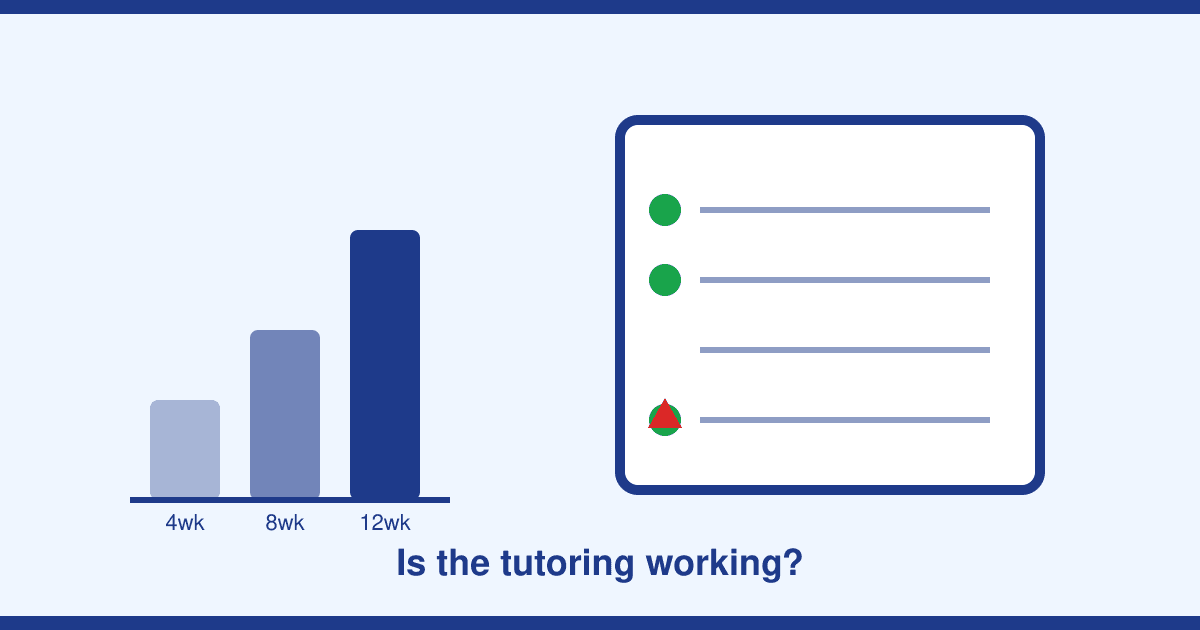
By around four weeks, the most reliable sign is behavioural rather than academic: a child settles into the routine, brings the right materials without reminders, and starts a homework task without the same resistance as before. Confidence in the specific subject, not overall confidence, is what to watch for, such as attempting a question rather than skipping it. Test scores at this point are not a fair measure; a single month rarely changes a class test result.
By around eight weeks, homework independence should be more visible. A child who previously needed a parent to sit with them for every piece of work should be starting some of it alone, even if it still needs checking afterwards. Class test scores and short assessments are the first fair place to look for movement, and teacher comments often shift from generic to specific, naming a particular skill that has improved.
By around twelve weeks, roughly a school term, the picture should be reasonably clear. Homework independence should be established for routine tasks. Class test scores, and where relevant a mock exam, should show some improvement, even if a full grade has not yet moved, and teacher comments should be more positive or specific, rather than repeating the concern raised before tutoring started.
Asking for a progress report, and what a good one contains
Most tutoring platforms and independent tutors will provide a progress update if asked, but the quality varies, and a vague one is not much use. It is reasonable to ask for a short written report every four to six weeks rather than relying on a verbal comment at the end of a session. A report worth reading typically contains:
- The specific topics or skills covered since the last update, not just the subject in general
- An honest note on what is still weak, alongside what has improved
- How the tutor's view compares with what the school is currently teaching or has recently tested
- A named target for the next few weeks, rather than "keep practising"
- A sample of the child's own work, marked, so the parent can see actual output rather than a summary
A tutor who cannot produce any of this after two months of weekly sessions either has not been keeping notes or has no clear plan, both worth raising directly.
Weigh school evidence alongside the tutor's own account
A tutor's account of progress is useful but not independent evidence. Class test results, mock grades and comments from the child's actual subject teacher come from someone with no stake in the arrangement, which makes them a more reliable check than the tutor's own assessment alone. Where the two disagree, for example a tutor reporting strong progress while class test scores stay flat, that gap is worth asking about. A useful habit is to bring the school's most recent test paper or teacher comment to the tutor and ask them to respond to it directly, which also tests whether the tutor is working from what the school is actually doing.
Warning signs, and how they read at different stages
Some of what looks like a warning sign is normal in the first few weeks and only becomes a genuine concern if it persists.
| Stage | Usually fine at this point | Worth raising if it persists |
|---|---|---|
| First 4 weeks | Some awkwardness settling in; child still hesitant with the tutor | Sessions are mostly the tutor watching the child do homework with no other input |
| 4 to 8 weeks | Slow, uneven improvement; occasional off day | No sense of a plan; the tutor cannot say what comes next |
| 8 to 12 weeks | Some topics still weak while others have clearly improved | Repeated late cancellations or rescheduling from the tutor's side |
| Ongoing, any stage | — | The child visibly dreads sessions rather than being neutral or mildly reluctant |
| Ongoing, any stage | — | No contact with the parent beyond payment reminders |
Beyond the table, a few signs are concerning at any stage:
- Sessions have quietly become homework help rather than teaching, with no topics introduced that the school has not already covered
- There is no plan the parent can see or ask about, even a rough one
- Cancellations or lateness from the tutor are frequent rather than occasional
- The child's attitude to the subject has got worse since tutoring started, not better
- The tutor never initiates contact with the parent, and updates only happen when asked for
Raising concerns, notice periods and payment terms
Most of these issues are worth raising directly with the tutor before assuming the relationship has failed. A short, specific message, such as asking what topics are planned for the next month or requesting a written progress note, is usually enough to show whether the gap is a communication problem or a genuine one. Our guide to questions to ask before hiring a tutor covers what to check at the outset, but two things are worth confirming again partway through: the notice period required to end sessions, since some tutors and platforms ask for one to two weeks' notice rather than an immediate stop, and the payment terms, including whether fees are paid per session or in a block, and what happens to sessions paid in advance if the arrangement ends early. These are usually in the original booking terms, worth re-checking before raising concerns so a decision is not complicated by a forfeited payment.
Switching tutors without losing continuity, and knowing when to stop
Changing tutor need not mean starting from nothing. Before ending an arrangement, ask the outgoing tutor for a short handover: topics covered, topics still to do, recent mock or class test results, and any pattern in the child's mistakes. A new tutor who receives this on day one can pick up the topic list rather than re-diagnosing everything, which otherwise costs several sessions. It is reasonable to request this even where the relationship has been difficult; it is a small, practical ask, not an emotional one.
Tutoring has usually done its job when a child completes routine homework independently, class test and mock results are at or close to target and holding steady, and teacher comments no longer flag the concern that prompted tutoring in the first place. Some families stop altogether at that point; others reduce to a lighter arrangement, such as fortnightly sessions ahead of exams, which our GCSE tutoring timeline covers in more detail. Stopping is not a sign that tutoring failed; for many families it is the intended outcome.
Sources: Education Endowment Foundation, Teaching and Learning Toolkit, entries on one-to-one tuition and small-group tuition; Ofqual, GCSE 9 to 1 grading guidance; SEND Code of Practice guidance on education, health and care plans; Joint Council for Qualifications, guidance on access arrangements. Individual school reporting formats and tutoring platform terms vary; check the specific terms provided at booking.
Frequently asked questions
Behavioural signs such as calmer homework habits often appear within the first month. Class test scores and teacher comments are a fairer measure from around eight weeks, and by twelve weeks, roughly a school term, there should be some measurable movement on the school’s own evidence, not just the tutor’s account.
A useful report names the specific topics covered since the last update, gives an honest view of what is still weak, compares that with what the school is currently teaching, sets a clear target for the coming weeks, and includes a sample of marked work rather than a general summary.
Sessions turning into homework help with no new teaching, no visible plan, frequent late cancellations from the tutor, a child who dreads sessions rather than being mildly reluctant, and little or no contact from the tutor beyond payment reminders are all worth raising directly.
Confirm the notice period in the original booking terms, check the payment terms including what happens to any sessions paid in advance, and ask the outgoing tutor for a short handover covering topics completed, topics remaining, and recent test or mock results so the new tutor is not starting from nothing.
Usually once a child can complete routine homework independently, class test or mock results are at or near target and holding, and the concern that prompted tutoring no longer appears in teacher comments. Some families stop entirely at that point; others move to a lighter, occasional arrangement instead.