GCSE Science Tutoring: Combined vs Triple Science, and What Tutors Do
Science is the subject where GCSE tutoring queries most often start with a question about structure rather than grades: is my child doing Combined Science or Triple Science, and does that change what a tutor should focus on? It is a reasonable question, because the two routes cover different amounts of content, lead to different numbers of qualifications, and place different demands on both the pupil and the tutor.
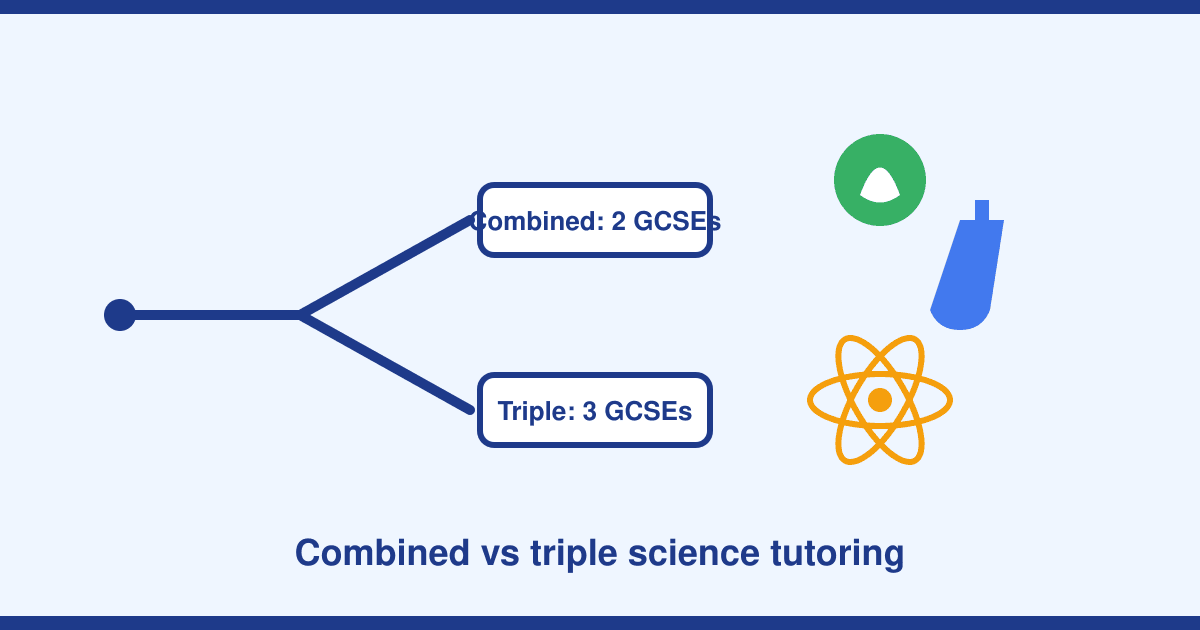
In short: Combined Science awards two GCSEs from six exam papers spread across biology, chemistry and physics, while Triple Science awards three separate GCSEs, one per subject, with more content in each. The route is usually chosen by the school rather than the family. Tutoring for Combined Science tends to work best as one subject taught across all three sciences; tutoring for Triple Science often needs a specialist in each subject once the pupil reaches the more demanding content in Year 11.
The two routes
Combined Science, sometimes called Combined Science: Trilogy or Double Award depending on the exam board, is examined as biology, chemistry and physics but reported as two GCSE grades, such as 6-6 or 5-4. It is built from six papers, two in each science, and every pupil sits content from all three subjects regardless of which one they find easiest. Triple Science, also called Separate Sciences, results in three GCSEs: one in biology, one in chemistry and one in physics, each graded independently on the same 9 to 1 scale, where a 4 is a standard pass and a 5 a strong pass. Triple Science covers more material in each subject and is the usual entry requirement for A-level science at many sixth forms, particularly for pupils intending to continue with more than one science.
Both routes are set by exam boards, principally AQA, Pearson Edexcel, OCR and WJEC Eduqas, and both are examined at the end of Year 11 in the normal May to June season, with results published in August alongside every other GCSE. Board and paper structure vary, so the specific revision reading list should always come from the school rather than be assumed.
Who decides, and what it means for tutoring load
In most schools, the choice between Combined and Triple Science is made by the school, not the family, and it is usually driven by timetabling and staffing rather than by a pupil's ability. Some schools offer Triple Science as an option pupils apply for; others place pupils into it based on Key Stage 3 attainment; a smaller number offer only Combined Science. Where there is a genuine choice, it is worth asking the school directly rather than assuming, because the tutoring plan differs materially between the two.
- Combined Science means one subject with three strands. A single tutor who is comfortable across biology, chemistry and physics can cover the whole course, and sessions can rotate between the three sciences according to where the mock results show weakness.
- Triple Science means three GCSEs' worth of content and, from Year 11 onward, three sets of past papers, three sets of required practicals and often three separate mock exams. The tutoring load is genuinely larger, and the case for a subject specialist in each science becomes stronger the closer the pupil gets to the exams.
- Moving between the two happens occasionally, usually if a pupil is struggling with the pace of Triple Science; a tutor who understands both specifications can help a family judge whether that conversation with the school is worth having.
Required practicals and how they appear in exams
Every GCSE science specification includes a set list of required practical activities that pupils are expected to carry out during the course, covering skills such as measuring, using equipment safely and processing results. Since these are examined through written questions rather than a separate practical assessment, a pupil does not need to remember the exact experiment they did in the school lab so much as understand the method, the variables involved and the sources of error, because exam questions frequently describe an unfamiliar version of a required practical and ask the pupil to apply the same reasoning to it. This is one of the most common places marks are lost: pupils who can describe a practical they carried out struggle when the same practical is presented in a different context or with different equipment. A tutor's job here is to practise the underlying method, not just the memory of the lesson.
The maths hidden inside science
A substantial share of the marks in every GCSE science paper depend on mathematical skills: rearranging an equation before substituting numbers into it, reading and drawing graphs, calculating gradients, converting units, and working with standard form and significant figures. Physics carries the heaviest maths content, but chemistry calculations, such as those involving moles or percentage yield, and biology maths, such as magnification and ratios, appear regularly too. This is why a pupil who is confident in science lessons can still lose marks steadily across a paper: the science understanding is there, but a shaky grasp of algebra or unit conversion caps the mark on almost every calculation question. Tutors who treat science tutoring as partly maths tutoring, checking equation rearrangement and graph skills explicitly rather than assuming they transfer from maths class, tend to see the fastest improvement in calculation questions.
What a tutor does in each science
| Subject | Where marks are commonly lost | What a tutor typically works on |
|---|---|---|
| Biology | Long-answer and evaluate-style questions; required practical variables | Structuring extended answers, applying practical method to unfamiliar contexts |
| Chemistry | Calculations (moles, mass, percentage yield); balancing equations | Step-by-step calculation method, unit consistency, equation practice |
| Physics | Equation rearrangement; graph reading; unit conversion | Explicit maths drilling alongside the physics content, past-paper calculation questions |
One generalist tutor or three specialists
For Combined Science, a single tutor who covers all three strands is usually the practical choice, since the course is designed to be taken as one subject and a generalist science tutor can move between biology, chemistry and physics within a session as the mock results dictate. For Triple Science, the calculation is different. Early in Year 10, one tutor across all three sciences can still work well, because the content gap between subjects is smaller. As the course progresses into Year 11 and the three specifications diverge in depth, particularly in physics, families with the resources to support three separate GCSEs often move to a subject specialist for whichever science is furthest below target, keeping a generalist for the other two. The Education Endowment Foundation's Teaching and Learning Toolkit finds that regular one-to-one tuition adds around five months of additional progress on average and small-group tuition around four months, with the largest gains where sessions are tied closely to what the school is teaching and to recent mock results, which argues for starting the conversation with a tutor as soon as the route and the weak subject are clear rather than waiting for the final term.
Any tutor working with a child who has additional needs, whether through an EHC plan under the SEND Code of Practice or exam access arrangements such as extra time agreed through JCQ, should be told about this before sessions start, so that practice papers and pacing match what the pupil will actually get in the exam. As with any tutor, a current DBS check is worth confirming, alongside the questions covered in our guide to questions to ask before hiring a tutor. Typical costs for subject specialists versus generalist science tutors are covered in our article on tutoring costs, and families weighing up when to begin should also see our GCSE tutoring timeline.
Sources: Ofqual, GCSE 9 to 1 grading guidance; Joint Council for Qualifications, summer examination timetables and information on access arrangements; exam board specifications for combined and separate sciences from AQA, Pearson Edexcel, OCR and WJEC Eduqas; Education Endowment Foundation, Teaching and Learning Toolkit, entries on one-to-one tuition and small-group tuition; Department for Education, SEND Code of Practice. Specification content, tiering and the exact required practicals vary by exam board and by school; check the school for the board in use.
Frequently asked questions
Combined Science, examined across six papers in biology, chemistry and physics, results in two GCSE grades. Triple Science, also called Separate Sciences, results in three independent GCSEs, one per subject, with more content in each. Both are graded on the same 9 to 1 scale and examined at the end of Year 11.
Usually the school, based on timetabling and staffing rather than a pupil choosing freely. Some schools let pupils apply for Triple Science, others place pupils into it using Key Stage 3 results, and some offer only Combined Science. Families should ask the school directly rather than assume.
Required practicals are assessed through written exam questions rather than a separate practical mark. Questions often present an unfamiliar version of a practical a pupil carried out in class and ask them to apply the same method, variables and error reasoning, which is why understanding the underlying technique matters more than remembering the specific lesson.
A significant share of marks in every science paper depend on mathematical skills such as rearranging equations, reading graphs, converting units and using standard form. Physics carries the most maths, but chemistry and biology calculations appear too, so a pupil who understands the science can still lose marks through weak maths technique.
Early in the course, one tutor covering all three sciences usually works well. As the specifications diverge in depth through Year 11, especially in physics, many families move to a subject specialist for whichever science is furthest below target while keeping a generalist for the other two.