National 5, Higher and Advanced Higher: How Tutoring Works in Scotland
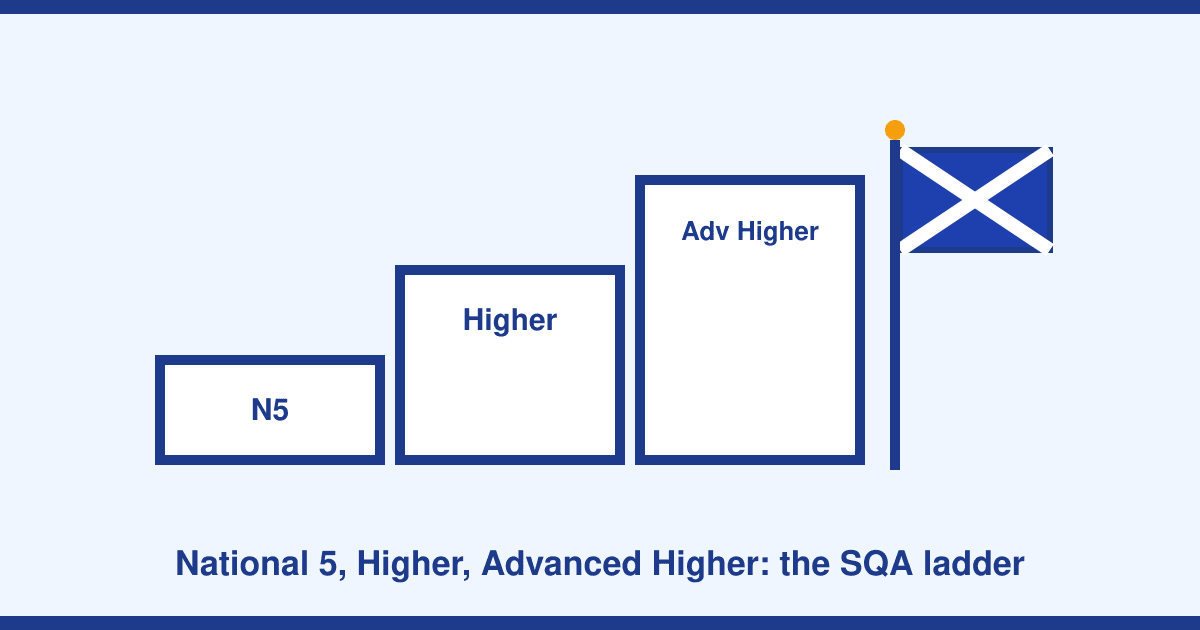
Scotland does not use GCSEs and A-levels. Schools follow the Scottish Qualifications Authority (SQA) framework, set within the wider Curriculum for Excellence that Education Scotland oversees, and the ladder runs through National 4 and National 5, Higher, and Advanced Higher. Families who have moved from England, Wales or Northern Ireland, or who are simply tutoring a Scottish pupil for the first time, often assume the two systems map onto each other neatly. They do not, and the differences change when tutoring is most useful.
In short: National 4 and National 5 are typically taken in S4, Higher in S5, and Advanced Higher in S6, with each course normally completed in a single school year rather than the two-year span of a GCSE or A-level course. The Higher is the qualification most Scottish universities use for entry, which makes the S5 year short, intense and the point where tutoring tends to pay off most. Prelims, the school's own mock exams, usually fall in winter and are the clearest signal of where a pupil stands before the real exam diet in April to June.
The SQA ladder, and how it differs from GCSEs and A-levels
The Scottish system is built around single-year courses rather than the two-year GCSE and A-level model used elsewhere in the UK. National 4 and National 5 are typically studied in S4, the year that corresponds roughly to Year 11 in England. Pupils then move into Highers in S5, and some continue into Advanced Highers, or take further Highers, in S6.
Three points follow from that structure:
- Everything moves faster. A Higher covers, in one school year, ground that would often be spread across a two-year A-level course. There is less time to recover from a slow start.
- The Higher is the main university entry currency. Scottish universities generally make offers on Higher grades, sometimes with an Advanced Higher condition attached, so S5 carries weight that A-level students only feel in Year 13.
- S6 is flexible. Some pupils take Advanced Highers in S6 to deepen a subject before university. Others, particularly those who did not sit as many Highers as they wanted in S5, take a "crash" Higher in S6: a Higher compressed into a single year alongside other S6 subjects, which asks a lot of a pupil in a short space of time.
The exam calendar and prelims
SQA exams, known as the exam diet, are sat across a window that runs from April to June, with results issued in early August. That calendar sits close to the GCSE and A-level timetable, but the courses feeding into it are shorter, so a pupil has less runway to prepare.
Before the real diet, schools run their own mock exams, usually called prelims, typically in winter. Prelims matter for two reasons. They give the school evidence for a course estimate, which can matter if an SQA result is later appealed, and they are the single clearest early warning a family gets about how a pupil is coping with the pace of a one-year course. A poor prelim in December leaves several months to act; a poor prelim in February leaves considerably less.
Where tutoring fits: S4 to S5 to S6
The table below sets out what is happening at each stage and what a tutor can realistically achieve.
| Stage | What is happening at school | What tutoring can realistically achieve |
|---|---|---|
| S4 (National 4/5) | Foundation content is taught; National 5 in most subjects runs across the year with an exam at the end | Fix gaps from earlier years before they compound; build the study habits a one-year Higher course will demand |
| S5 (Higher), autumn | A full year's content begins immediately, often with no recap of National 5 material | The most productive period: weekly sessions can keep pace with new content from week one, before gaps open up |
| S5 (Higher), winter | Prelims, typically December to February | Use prelim results to target the two or three topics losing the most marks; this is the clearest data point of the year |
| S5 (Higher), spring to exam diet | Course content finishes; revision and past papers | Shift to exam technique, timing and SQA mark schemes; little room left to teach new content |
| S6 (Advanced Higher or crash Higher) | Advanced Higher extends a subject in depth, or a crash Higher compresses a full course into one year | For Advanced Higher, support with extended, more independent work; for a crash Higher, the same intensity of support as an S5 Higher but with less time |
The practical conclusion is that a tutor who starts with a Higher pupil in September has close to a full school year to work with, while one who starts after the winter prelims is working with a matter of months on a course that was already designed to be tight.
What tutors do for maths, English and science Highers
The subjects that most commonly bring families to tutoring are Higher Maths, Higher English and the Higher sciences, and the tutoring looks different in each.
Higher Maths builds directly on National 5 techniques and moves quickly into new material, so a tutor's early job is often to confirm that the National 5 foundations are solid before the pace picks up. As the year goes on, the focus shifts to past-paper technique and the specific style of multi-step questions the course is known for.
Higher English centres on close reading and a critical essay, often drawing on a Scottish set text, alongside a folio of coursework completed earlier in the year. Tutors here spend more time on essay structure, textual analysis and how marks are actually awarded than on any single fact to be learned.
Higher sciences (Biology, Chemistry and Physics) combine exam content with an assignment component completed during the course. A tutor familiar with the course can help a pupil plan the assignment early, rather than let it compete for time with exam revision in the spring.
Tutor availability: Glasgow, Edinburgh and online
Scotland's two largest tutor markets are Glasgow and Edinburgh, where in-person sessions are widely available across most subjects and stages, including Advanced Higher in less commonly tutored subjects. Families outside those cities, or in areas where a particular Advanced Higher subject has few local specialists, are increasingly served by online tutoring, which removes travel time in a year where that time is often scarce. Given how short the Higher year is, availability matters more in Scotland than it does for a two-year A-level course: a family that waits until after prelims to look for a tutor is choosing from a narrower field than one that starts in September.
Questions to ask a tutor about SQA familiarity
Not every tutor who is strong at GCSE or A-level teaching understands the SQA system well. Before booking, it is worth asking:
- Have you tutored National 5, Higher or Advanced Higher pupils in this subject before, and for which exam diet?
- Are you familiar with the SQA course specification and how the exam paper is structured, including any assignment or coursework component?
- Do you know when this pupil's school typically runs prelims, and can sessions be timed around them?
- How will you use prelim results to focus the remaining sessions?
- What relevant background checks do you hold? (See our article on DBS checks for what to look for, and note that in Scotland the equivalent is membership of the PVG scheme, run by Disclosure Scotland, rather than a DBS certificate.)
The wider questions are the same ones set out in our guide to questions to ask before hiring a tutor, and typical rates for each stage are covered in our separate article on tutoring costs. Families used to the two-year GCSE runway described in our GCSE tutoring timeline should adjust their expectations: in Scotland, that runway is roughly half as long, and the decision to start tutoring tends to matter correspondingly sooner.
Sources: Scottish Qualifications Authority (SQA), course and assessment guidance for National 5, Higher and Advanced Higher; Education Scotland, Curriculum for Excellence guidance; Education Endowment Foundation, Teaching and Learning Toolkit, entries on one-to-one and small-group tuition. Prelim timing and course structure vary between schools and subjects; check with the school for the exact calendar.
Frequently asked questions
They are stages on the Scottish Qualifications Authority ladder, typically taken in S4, S5 and S6 respectively. Each is normally a one-year course, unlike the two-year GCSE and A-level courses used elsewhere in the UK, and the Higher is the qualification most Scottish universities use for entry.
The exam diet runs from April to June, with results issued in early August. Before that, schools run their own mock exams called prelims, typically in winter, which give an early and useful signal of how a pupil is coping with the pace of the course.
It is a Higher taken in a single S6 year by a pupil who did not sit it in S5, often alongside Advanced Highers or further Highers. It compresses a full course into one year, which asks a lot in a short time and is a stage where tutoring support is commonly sought.
As close to the start of S5 as possible. A full year of content begins immediately with little recap of National 5 material, so a tutor who starts in September has close to a full school year, while one who starts after the winter prelims has considerably less time to work with.
Yes, where possible. A tutor experienced with GCSEs and A-levels may not know the SQA course structure, the assignment components in Higher sciences, or when prelims typically fall. Asking about direct National 5, Higher or Advanced Higher experience is one of the more useful questions to put to a prospective tutor.