GCSE English Language and Literature: Two GCSEs, and What a Tutor Covers in Each
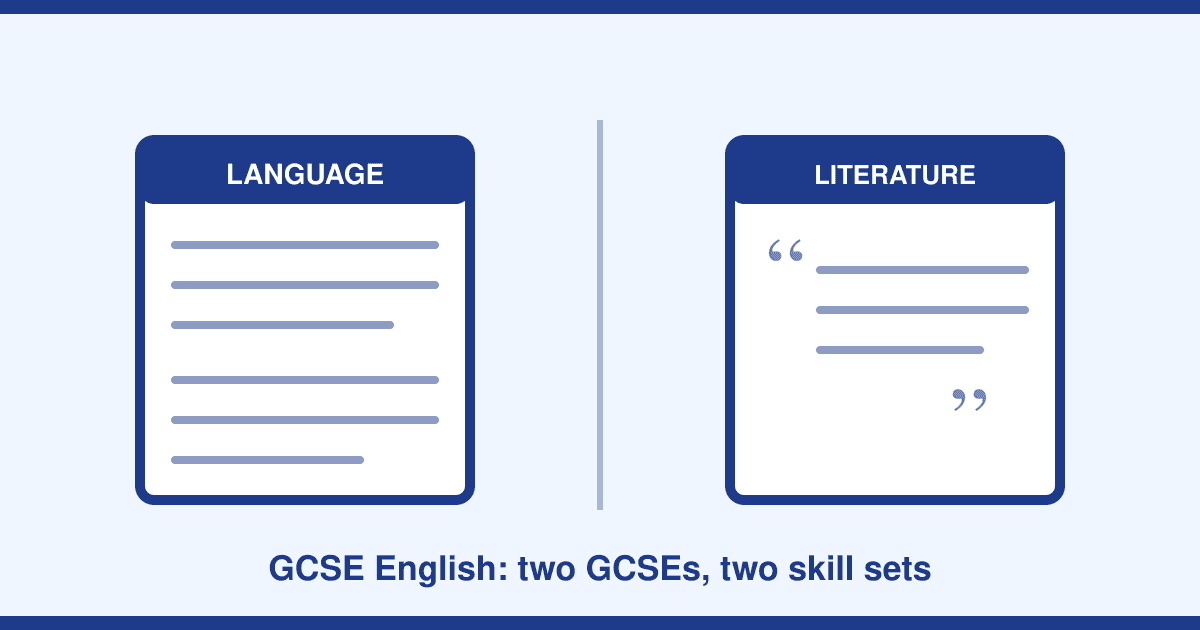
"GCSE English" is usually spoken of as a single subject, but almost every pupil in England, Wales and Northern Ireland sits two separate GCSEs under that heading: English Language and English Literature. They are graded separately and assessed against different skills. A pupil can hold a strong grade in one and a weaker grade in the other, and the reasons are rarely about how much a child reads.
In short: English Language tests reading unseen fiction and non-fiction extracts and writing to a purpose, both creatively and persuasively. English Literature tests close knowledge of set texts, usually a Shakespeare play, a 19th-century novel, a modern prose or drama text and a poetry anthology, examined through extract-based and essay questions, often without the text in the room. Pupils who read widely can still underperform because both subjects reward technique, timing and structure as much as understanding. A tutor's job differs between the two, and knowing which one a pupil is actually struggling with is the first step.
Two GCSEs, two different skill sets
English Language assesses a pupil's ability to read texts they have never seen before, in the exam itself, and to write for a stated purpose and audience. The reading material is usually a mix of fiction and non-fiction extracts, and questions ask pupils to explain what a writer has done and why. The writing component covers both creative writing, such as a descriptive or narrative piece, and transactional writing, such as a letter, article, speech or piece of persuasive writing.
English Literature assesses how well a pupil knows a fixed set of texts studied over the course, typically a Shakespeare play, a 19th-century novel, a modern prose or drama text, and a poetry anthology alongside an unseen poem. Most exam boards run this as a closed-book exam, meaning pupils answer from memory rather than with the text open in front of them, so quotations have to be learned rather than looked up.
Both GCSEs are compulsory in most schools, both are sat in the May to June exam period, and both appear on the results slip in August, graded 9 to 1, where a 4 is a standard pass and a 5 a strong pass. The exam board a school uses, AQA, Pearson Edexcel, OCR or WJEC Eduqas, sets its own texts and structure, so a tutor needs to know which board and set texts a pupil is working with before the first session. The two subjects reward different things:
| Aspect | English Language | English Literature |
|---|---|---|
| Texts | Unseen fiction and non-fiction extracts, seen for the first time in the exam | Set texts studied throughout the course: a Shakespeare play, a 19th-century novel, a modern text, a poetry anthology plus an unseen poem |
| Writing required | Creative writing (narrative or descriptive) and transactional writing (letters, articles, speeches, persuasive pieces) | Essay-style responses on character, theme, form and language, generally without the text open in front of the pupil |
| Skills rewarded | Comprehension, inference, comparing writers' viewpoints, controlling tone and structure for a stated purpose | Close analysis of quotation, contextual knowledge, sustaining an argument across a whole text |
| Typical demand under time | Working quickly through unfamiliar material and planning a piece of writing from a blank page | Recalling accurate quotations and applying them to the specific question asked |
Why a good reader can still score poorly
Fluent, enthusiastic readers regularly bring home disappointing English grades, and it is rarely a comprehension problem. Both GCSEs are marked against published assessment objectives, which reward specific skills such as analysing language choices or structuring an argument, not simply understanding a text. Common reasons a capable pupil loses marks include:
- Answering the topic rather than the question. Command words such as "explore", "compare" and "evaluate" ask for different things, and a well-written answer to the wrong task scores poorly.
- Running out of time on the final question because too long was spent on the first, which is a frequent cause of a weak Language paper mark despite strong writing earlier in the same script.
- Quoting from memory inaccurately in Literature, or quoting correctly but not explaining what the quotation shows.
- Weak paragraph and essay structure, so that good ideas are present but not built into a sustained argument the marker can follow.
- Treating creative writing as free writing rather than as a piece with a deliberate structure, viewpoint and controlled ending.
What a tutor actually does, subject by subject
In English Language, a tutor typically works on planning paragraphs before writing, teaching transactional writing structures for letters, articles and speeches, practising comparison of unseen non-fiction extracts, and running timed writing so pacing across a whole paper becomes automatic.
In English Literature, the work centres on quotation analysis, building a bank of short, precise quotations for each set text rather than long passages that are hard to recall accurately, practising essay plans under time pressure, and using retrieval practice so that context and quotations are secure for a closed-book exam. Poetry comparison tends to need separate, repeated practice because it combines quotation recall with an unfamiliar poem on the day.
In both subjects, a tutor working from the exam board's published mark scheme can show a pupil which words or techniques earn credit, usually more useful than a model answer alone because it makes visible the gap between what was written and what the marker wanted.
How many sessions, and when to start
The Education Endowment Foundation's Teaching and Learning Toolkit reports that one-to-one tuition adds around five months of additional progress on average, and small-group tuition around four months, with the largest effects from regular sessions over a full term rather than occasional ones. For English specifically, one session a week per subject from Year 10 or the start of Year 11 gives enough time to build a quotation bank for Literature and practise a full range of writing tasks for Language before revision narrows to past papers. Our GCSE tutoring timeline sets out the wider calendar, including how mock results in the autumn term of Year 11 should shape the final push.
Choosing an English tutor
Because the two GCSEs are marked differently, it is worth checking that a prospective tutor treats them as separate subjects rather than one general "English" offer.
- Confirms the exam board and, for Literature, the specific set texts before the first session.
- Explains how they will build and test a quotation bank, not just discuss the texts.
- Sets timed writing tasks for Language, not only discussion of technique.
- Works from, or is familiar with, the published mark scheme for the relevant papers.
- Holds a current DBS check, covered in our article on DBS checks, and can explain how progress will be reported.
The broader questions to ask, including experience with the specific course and how sessions are structured, are set out in our guide to questions to ask before hiring a tutor. Typical rates by level and format are covered separately in our article on tutoring costs.
Pupils with English as an additional language
A pupil who is fluent in everyday spoken English can still find GCSE English Literature disproportionately hard, because the set texts often use vocabulary, idiom and cultural or historical reference that is unfamiliar even to a confident conversational speaker. Useful tutoring support tends to focus on pre-teaching vocabulary before a text is studied in class, building context notes that explain references a British-educated pupil might absorb without noticing, and extra practice at sentence-level accuracy in written work. Some pupils may also be eligible for JCQ access arrangements such as extra time, though this is assessed and applied for by the school, generally alongside its SEND provision, rather than by a tutor. It is worth asking the school early, since applications have deadlines well before the exam period.
Sources: Education Endowment Foundation, Teaching and Learning Toolkit, entries on one-to-one tuition and small-group tuition; Ofqual, GCSE 9 to 1 grading guidance; Joint Council for Qualifications, access arrangements guidance; exam board specifications from AQA, Pearson Edexcel, OCR and WJEC Eduqas. Set texts, paper structure and exact assessment objectives vary by board and by school; check the specification your child's school uses for precise detail.
Frequently asked questions
English Language tests reading unseen fiction and non-fiction extracts and writing to a purpose, covering both creative and transactional writing. English Literature tests close knowledge of set texts, usually a Shakespeare play, a 19th-century novel, a modern text and a poetry anthology, examined through extract-based and essay questions, often without the text available in the exam.
Yes, this is common. Language rewards comprehension of unfamiliar material and controlled writing under time pressure, while Literature rewards recalled quotation and sustained analysis of studied texts. A pupil can be a confident, imaginative writer and still lose marks in Literature for weak quotation recall, or vice versa.
A common pattern is one session a week per subject from Year 10 or early Year 11, over at least a full term. The Education Endowment Foundation reports around five months of additional progress on average for one-to-one tuition, with the strongest effects from regular, sustained sessions rather than occasional ones.
For Literature, the focus is usually a quotation bank, context notes and essay planning for closed-book recall. For Language, the focus is usually planning paragraphs before writing, transactional writing structures, comparing unseen extracts, and timed practice so pacing across the whole paper becomes automatic.
Often, yes, particularly for Literature, where set texts use vocabulary and cultural reference that can be unfamiliar even to a fluent speaker. Useful support includes pre-teaching vocabulary and building context notes. Extra time in exams is arranged by the school through JCQ access arrangements, not by a tutor.